2nd Webinar: ‘The Teacher-Leader in Film Education: A CIFEJ Conversation
April 1, 2026
New UNESCO Global Media and Information Literacy Board 2025-2027 announced!
April 24, 2026Sherri Hope Culver × Mitsuo Tahira
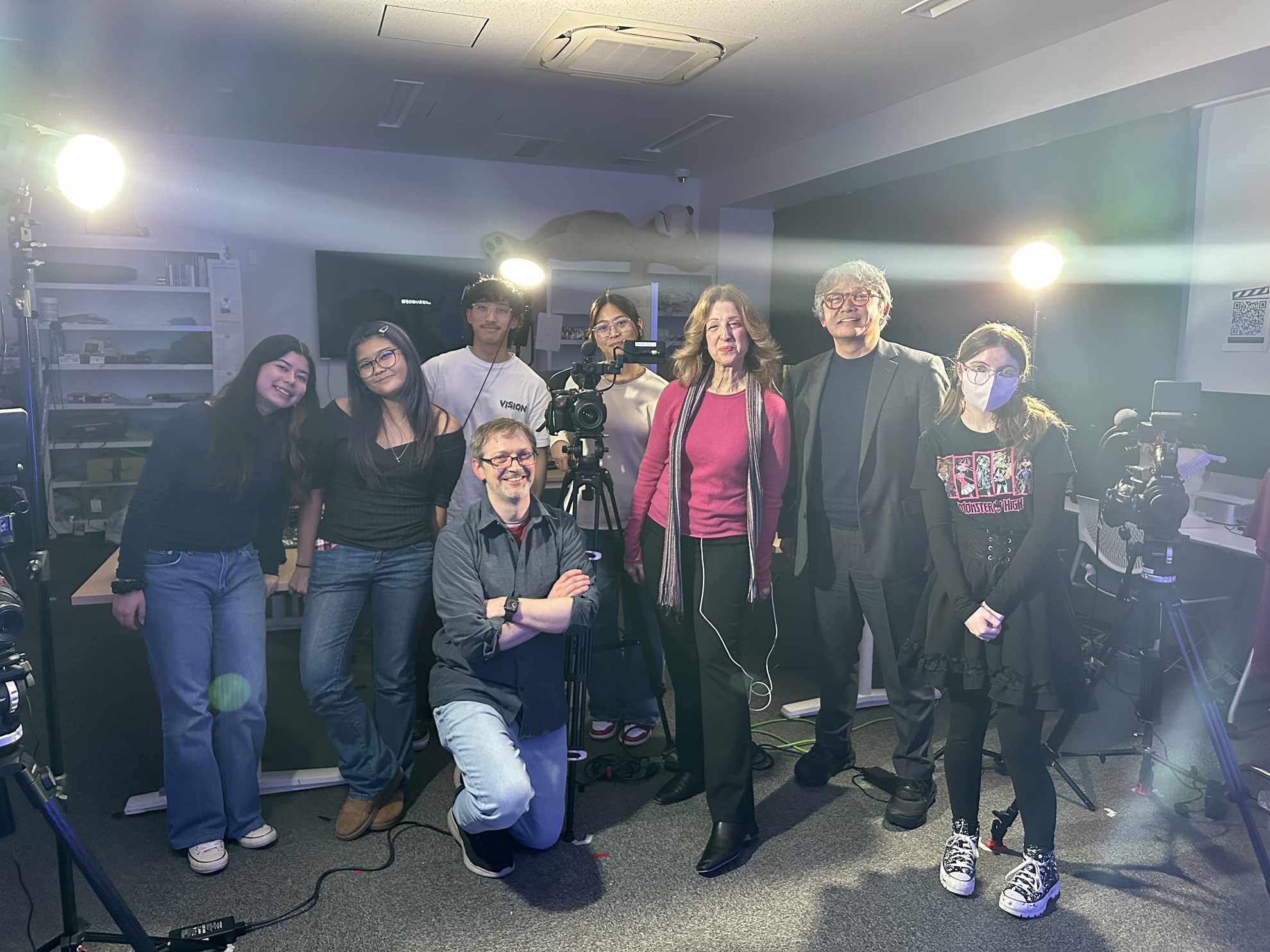
– This interview was conducted as a part of Mr. Tahira‘s appearance on the television show, Media Inside Out, produced and hosted by Ms. Culver –
Sherri:
Today, children can access video content anytime—at home, online, anywhere.
In such a world, why is it still meaningful to physically go to a film festival?
Mitsuo:
That’s a very good question. To be honest, it is something I sometimes wonder about myself.
But one thing is clear: when children enjoy a film festival, their parents enjoy it too.
We do not simply want children to see good films—we want adults to watch them alongside them.
The fact that parents and children can share the same time and the same experience is, in itself, one of the great values of a film festival.
And children’s happiness is created through the actions of adults. In that sense, adults also need good films.
Sherri:
That’s such an important perspective.
I believe one of the core values of children’s film festivals lies not only in the films themselves, but in the act of watching together.
Today, many children grow up without ever going to a cinema.
But being in the same space with others—laughing, being surprised, even feeling scared together—has a power that streaming simply cannot replace.
Mitsuo:
Yes, exactly.
At KINEKO, we screen around 60 to 70 films each year, and many of them are shown only once or twice during the festival period.
It is a precious opportunity to encounter outstanding works from around the world—films that are otherwise very difficult to see in Japan.
Children are able to imagine and almost physically feel the sounds, the colors, even the smells brought by a film.
I think that imaginative sensory experience is one of cinema’s great strengths.
Sherri:
The way children encounter films is also very important.
When I think about what kind of media is best for children, I always start with one question: What are we trying to communicate?
What makes film so powerful is its ability to tell stories.
And especially when those stories are told from a child’s perspective, they carry incredible strength.
Children respond deeply when they feel, “That’s me on the screen,” or “That feeling is mine.”
Mitsuo:
At KINEKO, we divide our programs according to age.
For example, in our program for children aged one to five, we structure about 60 minutes with four or five films.
Some are highly artistic, while others deal with difficult themes that may cause adults to reflect on themselves.
We choose films by constantly asking what children truly need.
By creating programs that can hold even a one-year-old’s attention for a full hour, we place great importance on reaching children’s sensibility.
I want children to be able to watch films so moving that even adults get goosebumps.
Sherri:
I really admire that approach.
Rather than oversimplifying content just because it’s for children, it’s important to respect their curiosity, creativity, and openness to the world.
Children naturally love to learn and can be deeply interested in lives and experiences different from their own with a little encouragement.
That’s why we need films and spaces that don’t underestimate them.
Mitsuo:
One of KINEKO’s major defining features is our live dubbing screenings.
That too was born from our desire not simply to screen films, but to create a stronger and more joyful experience of cinema.
Sherri:
Live cinema—that’s fascinating. How did that begin?
Mitsuo:
We started the festival in 1992, and the first five years were truly difficult.
One day, during a screening, I heard a child say, “Mom, let’s go home.”
It was a real shock to me.
After that, I kept thinking about the same questions year after year:
How can we make children want to stay until the end?
How can we encourage more people to come to the festival?
That is how Live Cinema was born.
In Japan, anime culture is highly developed, and voice actors are admired by both children and adults.
We hoped that by having voice actors perform live right in front of the audience, an ordinary film could become something much more exciting.
At times, as many as ten to fifteen voice actors stand beside the screen and engage in live dubbing.
I believe that our determination to delight audiences through this format is one of the reasons KINEKO has continued for more than thirty years.
Sherri:
That makes complete sense.
I once visited Cinekid in Amsterdam, where children didn’t just watch films—they also engaged with technology and creative activities around them.
They could move freely, play, create, and return to the screen.
In such a “playful” environment, a film festival becomes more than a place to consume films—it becomes a space that celebrates creativity itself.
KINEKO’s live cinema feels very playful in that sense.
It shows children that film is not just something to watch passively, but something they can engage with—physically, emotionally, even vocally.
To grow a festival, you have to grow your audience. Mitsuo Tahira
Mitsuo:
Thank you.
We do not want the festival to be merely a place where films are screened.
We want it to be a place where children can have experiences that truly matter.
Sherri:
And that’s incredibly important.
To me, KINEKO is not just a place to watch films—it’s a place where children feel valued.
Their perspectives are respected, and both childhood itself and its relationship with art are celebrated.
That kind of festival is not something you find everywhere.
Mitsuo:
Thank you.
I would not call it a “secret,” exactly, but I do believe that in the first ten or twenty years of a festival, it is important not to do just flashy stuff.
To grow a festival, you have to grow your audience.
You have to gradually increase the number of people who look forward to returning every year.
For the first ten years, we had very little exchange with other countries.
We focused on local families and concentrated on showing children films that were kind, but also challenging.
Sherri:
That sense of being rooted in the community is incredibly important.
There are large children’s film festivals around the world, but I truly believe that smaller, local festivals are just as essential.
For example, a small local cinema that invites families on a Saturday afternoon at an affordable price, creating a welcoming environment for children—that is also a meaningful contribution to film culture.
If the film industry is to continue, we must nurture children—not only as audiences today, but as audiences of the future.
Mitsuo:
That is absolutely true.
I would love for the whole city to enjoy the festival and come to love cinema—to become something like a parade, a celebration.
Even if the festival itself lasts only five or six days, I want to create an atmosphere in which the whole city seems to welcome children.
And for that to happen, adults have to work together.
A children’s film festival is not just a place to gather content for children. It’s a place where children feel valued, encounter the emotions and experiences of others, and expand their imagination. Sherri Hope Culver
Sherri:
In today’s society, opportunities for people from different backgrounds to gather in the same space and share an experience have become increasingly rare.
Film festivals are one of the few places where this can still happen.
People with different perspectives watch the same film and share the same moment.
That is a powerful experience—for both children and adults.
Mitsuo:
At the same time, children today are growing up not only with movie theaters, but also with social media, short-form videos, and streaming platforms.
What do you think about that environment?
Sherri:
It’s a very complex issue.
I don’t believe the answer is simply to ban these platforms.
Yes, social media can negatively affect children’s attention and well-being.
But taking it away doesn’t help them develop the ability to navigate media—that is, media literacy.
What we need is both protection and education.
Education for adults, and education for children themselves.
And importantly, technology companies must also take more responsibility.
Mitsuo:
I see.
At the festival too, we have just begun discussing AI and technology with our staff.
There are still many things we have not fully sorted out, but at the very least, I believe we need to distinguish between works created by human hands and works created by AI.
Because a film is something born by bringing together the talents of many people.
Sherri:
I’m very interested in that as well.
Technology itself is not the problem.
The question is: Who is it for, and how is it used?
If it expands children’s creativity, it holds incredible potential.
But if it is used to capture attention, cause harm, or create dependency, then we are dealing with a serious issue of responsibility.
Mitsuo:
The same may be true of running a film festival.
I manage a company while also running the festival, and I feel that this position gives me a certain balance.
If a festival relies only on sponsors or government funding, there is always the danger that its content will become biased.
Of course, support is something we are grateful for.
But relying on it too heavily is risky.
Because I have my own business, I can take responsibility for my decisions, and I can protect the principles of the festival.
Sherri:
That’s a very important perspective.
Culture and media for children are often framed as something inherently “good.”
But what truly matters is who supports them, and with what values.
Caring about children is not just about kind words—it’s about the choices we make:
what we show, what kind of space we create, and what we choose to protect.
Mitsuo:
Originally, I wanted to become a film director.
I started a business at twenty-five, and when I was twenty-seven, I visited the Kinder Film Fest in Berlin with my friends.
That was when I thought, “I want to create a festival like this in Japan.”
The first five years were brutal.
No audiences. Empty venues. Continuous losses.
It was so difficult that I often found myself wondering, “Why am I doing this at all?”
And yet I kept going, driven by the dream of creating the best film festival in the world.
Even if I do not accomplish that in my own generation, I hope that the next generation of directors will build a festival that stands closest in the world to children and parents.
Sherri:
I believe that spirit is reflected in the atmosphere of the festival.
A children’s film festival is not just a place to gather content for children.
It’s a place where children feel valued, encounter the emotions and experiences of others, and expand their imagination.
At the same time, it’s also a space for adults to reflect on what they want to pass on to the next generation.
In that sense, KINEKO is a very important festival.
Mitsuo:
Thank you very much.
I hope we can continue striving to create a festival that is special for children and unforgettable for families.
Sherri:
Yes.
What children need is not just access to images.
They need to encounter carefully chosen works, in thoughtfully designed spaces.
Film festivals that can create those encounters will only become more important in the future.
Sherri Hope Culver: UNESCO Global MIL Board, Director Center for Media and Information Literacy, Professor, Temple University, USA
Mitsuo Tahira: CIFEJ Board Member, Director of KINEKO International Film Festival, Japan